As a teenager, Vagabond sought out creative ways to shock himself—with low-voltage electronics, exposed wires, computer parts, you name it. As an adult, Mimsy was in a long-term relationship with a man who used to punch himself until he bruised. To an outside observer, these two behaviors might look very similar. After all, they both involve self-inflicted injury. But for Vagabond, shocking himself to feel sharp, sustained pain was a way to satisfy his masochistic desires, whereas Mimsy’s partner punched himself out of self-loathing and rage. In this post, we’ll explore the distinction between BDSM and self-harm—or, as the kink community might frame it, the distinction between hurt and harm.
How Common Are Masochism and Self-Harm?
Despite the fact that there’s very little research about the differences and similarities between BDSM—specifically masochism—and self-harm, these are not fringe activities. According to one study, nearly 14 percent of men and 23 percent of women reported engaging in masochism at least once, and an even greater percentage desired it (over 20 percent of men and more than 25 percent of women).
When it comes to self-harm, or nonsuicidal self-injury (NSSI), in adolescents, the percentages are similar. About 21 percent of girls and 14 percent of boys engage in it. The prevalence decreases with age, however. Studies show at least a 40 percent drop in NSSI between adolescence and age 30+, and these trends continue as we age.
Why BDSM and Self-Harm Look the Same
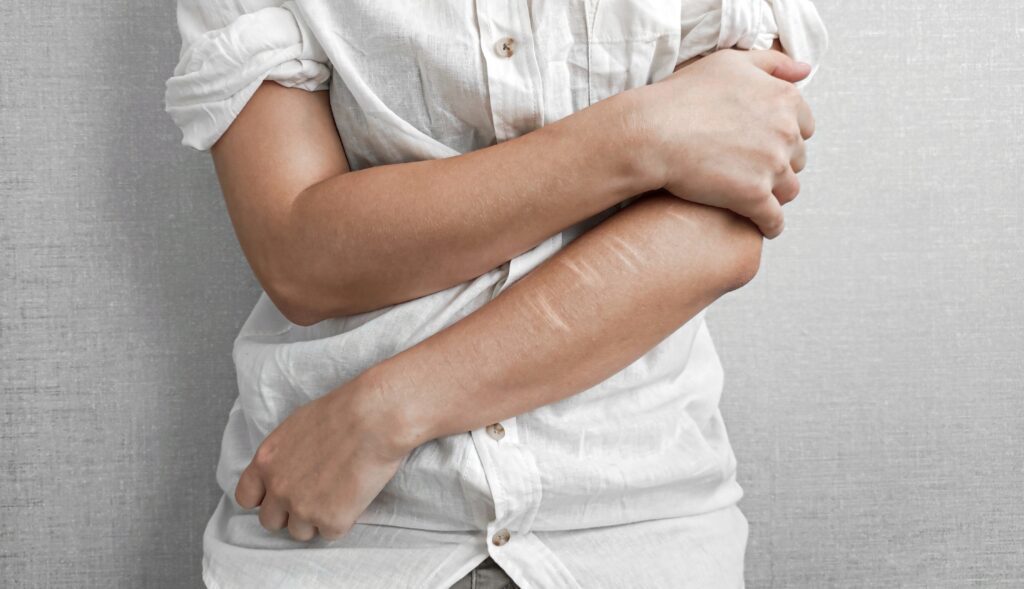
Before diving into the mentality and motivation behind BDSM and NSSI, let’s take a look at the visual and bodily similarities. NSSI is deliberate self-injury without the intent to die and without a sexual component. The most common forms include cutting, burning, scratching to the point of drawing blood, and hitting oneself. BDSM often involves sensation play or impact for sexual gratification, which can include flogging; spanking; and playing with sharps (knives, pinwheels, needles, etc.), hot wax, electric shocks, and so on.
With both NSSI and BDSM, the brain releases adrenaline and endorphins to manage the physical duress the body is under. And if you saw a photo of someone’s burn mark or bruise, you wouldn’t be able to tell whether it was the result of self-harm or a fun night at a dungeon.
BDSM vs. Self-Harm: Mental Health and Motivation
So if the biology and marks are the same, what distinguishes BDSM from self-harm? The answer lies in mental health and motivation.
There is no evidence that masochists (or BDSM practitioners generally) are any more likely to have mental illness than vanilla people. In fact, some studies have even found that kinksters are better off mentally. Conversely, research shows that the majority of people who self-harm have at least one mental health disorder, and self-harm is strongly associated with suicidal tendencies.
NSSI is primarily about attempting to cope with intense emotional distress. Motivations include the following:
- To reduce or distract from overwhelming emotions (anger, sadness, anxiety)
- To feel in control
- To punish oneself
- To combat emotional numbness
- To make inner pain visible or signal a need for help
In contrast, BDSM and masochism are primarily about the following:
- Power exchange and submission
- Sexual arousal and pleasure
- Enjoyment of pain
- Altered mental states (subspace—trance‑like or “floaty” states)
These differences in intent are highlighted in kinky sociologist Julie Fennell’s podcast episode on this topic. One of her guests, Cait, who has a history of cutting and is also into playing with sharps in a BDSM context, explains that it comes down to a difference in mindset that she has to gauge in herself. “Is it pleasurable masochism . . . is it sexy? Or is it self-punishment, self-hatred, darkness?”
Isolation vs. Connection
Another major difference between NSSI and BDSM is how it’s practiced. People who engage in self-harm almost always do so alone, in secret, and afterward, they often feel shame and attempt to hide what they’ve done. In the case of Mimsy’s ex, he would lie to people about how he got bruises on his face, saying he fell or got injured playing sports.
BDSM is often practiced with a partner and sometimes even in public settings, such as dungeons, where safeguards are built in. Whereas visible marks might be hidden from the vanilla world, they’re seen as points of pride within the kink community, not cause for concern or evidence of mental health struggles.
Given these differences, you might assume the two populations are separate, but the reality is more nuanced.
Overlap Between BDSM and Self-Harm
Do some people who start with self-harm “graduate” to BDSM as a healthier outlet? Unsurprisingly, it’s complicated. Anecdotally, there does seem to be a fair amount of overlap between people who have a history of self-harm and BDSM. Fennell notes in the podcast that at least 75 percent of the people who have rope bottomed for her have also self-harmed. Her two guests indicate that once they got into BDSM, their NSSI episodes became less frequent but were not eliminated entirely. In both cases, they started self-harming as teenagers and got interested in BDSM in their early 20s, so it’s difficult to know whether BDSM diverted them from self-harm or whether they simply began to age out of NSSI.
One study that explored BDSM and NSSI found that most participants had stopped NSSI once they started BDSM and theorized that kink may serve as a coping mechanism. But without knowing the ages of when the study participants engaged in self-harm vs. BDSM, it’s hard to know what caused what or whether there was any connection at all between stopping NSSI and starting BDSM.
A Double Standard
Finally, it’s worth asking why we view self-harm as a sign of mental instability when we celebrate other forms of self-inflicted pain.
Consider professional football players. The vast majority of retired players deal with chronic pain, and more than half report experiencing cognitive decline worse than other men their age. This is in addition to joint replacements, reduced mobility, and more.
These types of lifelong physical issues aren’t limited to contact sports. More than 90 percent of former ballet dancers experience musculoskeletal disorders, and many suffer from osteoarthritis.
Yet, societally, we view football players and dancers as hard-working athletes. Why? Because their pain is society’s gain. They score points or put on a beautiful performance for our entertainment. It serves a purpose culturally.
NSSI is stigmatized because it appears to have no productive output and is often a sign of emotional distress. BDSM occupies an awkward middle ground: It’s stigmatized by some vanilla folks yet celebrated among practitioners as a valid form of pleasure and connection.
But intent matters more than the label. BDSM can be approached with an unhealthy mindset. Mimsy knows this firsthand. Early in her kink journey, she sought out BDSM with people who reinforced feelings of low self-worth. If someone uses impact play to punish themselves or because they believe they deserve pain, that starts to look an awful lot like NSSI.
The reverse can also be true. Not all self-harm is indicative of a mental health crisis. For some people, it’s an imperfect but effective way to regulate emotions when no other tools are available.
The Takeaway
A distinction is often made in BDSM between hurt and harm. Hurt is the result of wanted pain that is negotiated and builds toward pleasure, connection, catharsis, or other positive outcomes. Harm involves serious physical or emotional damage. It does not have positive connotations.
Vagabond’s teenage electrical shocks were masochistic exploration that caused enjoyable pain. Mimsy’s ex’s punching, on the other hand, was harm born out of intense self-hatred. For people like Cait, the distinction requires constant self-awareness.
Pain is a tool that can be used for good or ill. What matters is whether the person using it feels empowered or trapped by it. With any pain, be it BDSM, NSSI, or athletics, ask yourself, Am I doing this because I get enjoyment from it or because I think I deserve to suffer? If it’s the latter, that’s probably worth exploring, perhaps with a therapist.