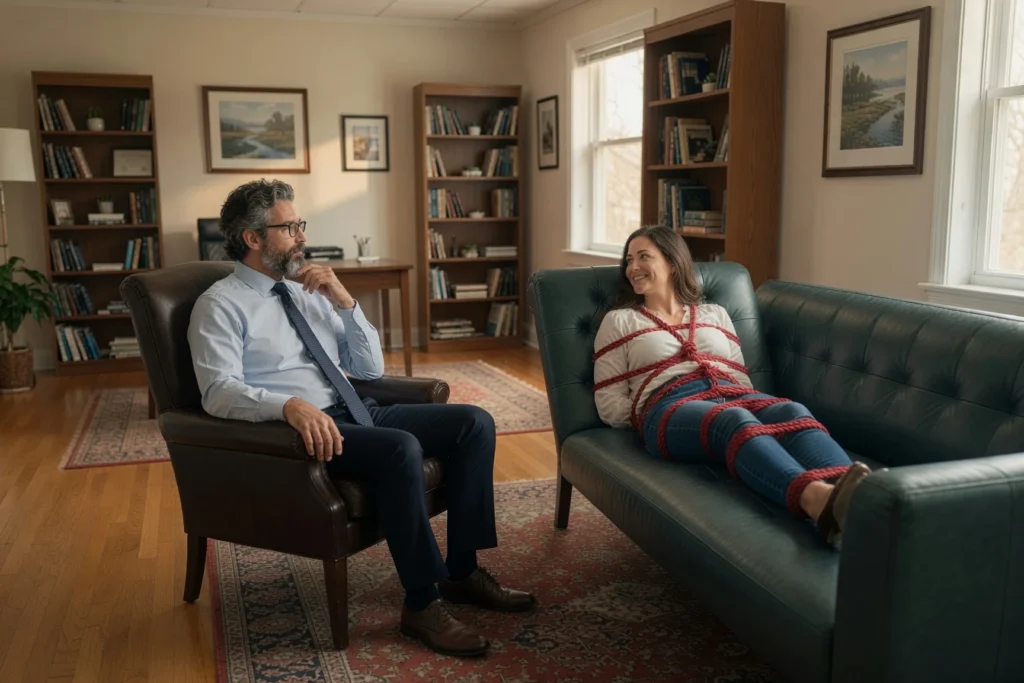
If you’ve ever been spanked, flogged, or tied up, you’ve likely felt your worries and responsibilities slip away, even if only for a brief time. Or perhaps you’ve experienced a deeper sense of catharsis that stays with you long after the scene ends. There’s no question that BDSM can be healing and therapeutic for many, but it’s not therapy.
Originally posted on September 25, 2018; updated on June 23, 2026
As an Amazon Associate, we earn from qualifying purchases made via one of the links below (at no additional cost to you).
When Mimsy first started getting in touch with her kinky side and learning about BDSM, she became obsessed with consensual non-consent (CNC). Also known as rape or ravishment play, CNC is a type of BDSM role-play in which the participants agree in advance to simulate a non-consensual act. This could resemble playful reluctance, full-blown abduction and “forced” sex, or myriad scenarios in between. Despite what it may look like, CNC is not assault. In fact, it’s one of the most carefully prepared types of play in BDSM. In this post, we’ll explain exactly what to consider as you plan a CNC scene.
As an Amazon Associate, we earn from qualifying purchases made via some of the links below (at no additional cost to you).
Many of the things BDSM players enjoy, like impact, CNC, and rope bondage, involve more risk than vanilla sex. In some cases, that’s even part of the appeal. It’s also why the BDSM community spends so much time emphasizing consent and safety. The thinking goes that as long as the people involved are consenting risk-aware adults, they can do what they want—a philosophy reflected in frameworks like SSC and RACK. We disagree and think it’s time to talk plainly about BDSM activities that are simply too dangerous to do. As cases ripped from the headlines show, consent alone isn’t enough. In this post, we’ll discuss a few kinks that should always be off limits, others that require education to do properly, and red flags everyone should watch out for.
Passionate romance, deep intimacy, erogenous zones, eye contact. This is not a list of ingredients in PG-13 sex scenes. These have all been claimed as “kinks” by people discussing sex online, along with bondage, pet play, D/s, and anything else that typically falls under the BDSM umbrella. If everything and everyone is kinky, what does the word even mean? Is it beneficial for the definitions of kink and BDSM to keep expanding? We’ll explore these questions and more in this post, starting with where these words came from and how we got here.
Have you ever wondered if your kinks are too weird or dark? Now, thanks to the largest kink survey in the known universe, we have the data to prove they aren’t. Aella, a rationalist, sex worker, and “survey artist,” has spent years running and refining a survey of nearly 300 kinky dimensions. As of today, the Big Kink Survey (BKS) has over a million respondents and offers an unprecedented look into our collective kinky psyche. Though it offers a treasure trove of data, its greatest insight isn’t about what people are into, but rather how surprisingly common all our kinks are. Here are five key takeaways from the BKS.