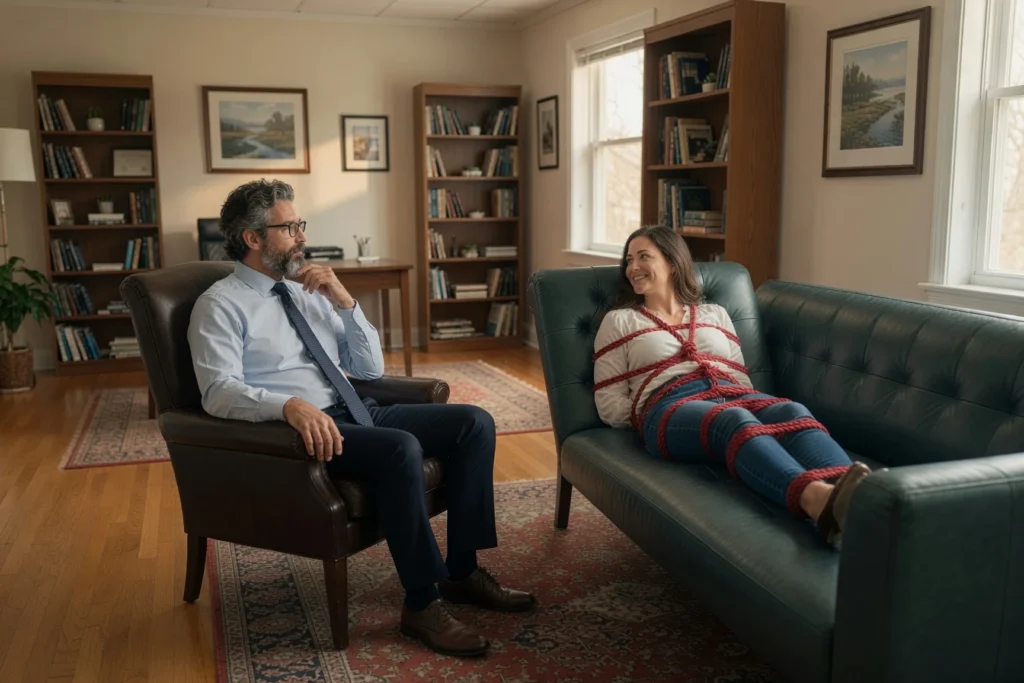
If you’ve ever been spanked, flogged, or tied up, you’ve likely felt your worries and responsibilities slip away, even if only for a brief time. Or perhaps you’ve experienced a deeper sense of catharsis that stays with you long after the scene ends. There’s no question that BDSM can be healing and therapeutic for many, but it’s not therapy.
“Sometimes being able to turn my brain off, even for a little while, is the most refreshing escape from reality.”
“[BDSM] helped me overcome my battle with self-harm.”
“As a child abuse survivor, it means I have a place where boundaries are not just okay, but encouraged. If I say “stop,” then everything stops, no excuses needed.”
These are just a sampling of myriad testimonials in online BDSM forums about the psychological benefits of BDSM. For many kinksters, BDSM functions as a release valve that enables them to give up or take control, escape stress and responsibility, process complex emotions, and—to use an overused phrase—be their authentic selves.
Although both doms and subs can experience positive mental effects, the idea of using BDSM to heal emotional wounds or trauma frequently pertains to subs. This is seen most intensely with some survivors of sexual assault who use BDSM—specifically CNC—to reenact and reclaim aspects of their experiences on their terms.
It’s clear that BDSM can be healing for many, but when this is conflated with actual therapy, it’s a problem. BDSM is not a substitute for clinical treatment with a trained professional, and it’s reckless for doms to position themselves as psychic healers or for subs to expect their doms to fix their mental health issues.
Why BDSM Gets Confused with Therapy
It’s easy to understand how this conflation happens, though. There’s copious anecdotal evidence indicating that people have used BDSM to improve their mental health. At the same time, BDSM is marketed as a form of “therapy” in some not-so-dark corners of the internet. While some practitioners note—albeit discreetly—that what they’re providing isn’t licensed therapy, others suggest that sex workers—not licensed therapists—are the best people to turn to for this so-called “therapy.” There’s no clinical definition of BDSM “therapy,” no standard of care, and no licensing body overseeing it. So why call it therapy at all?
As it happens, this isn’t a new question. Sociologist Danielle Lindemann spent months interviewing pro dommes in NYC and San Francisco in 2007 and 2008 and discovered that many of these women not only saw BDSM as therapeutic for clients but also referred to themselves as therapists. One domme noted that “there’s a lot of healing in people being accepted for their taboo . . . To be heard for who you are is very therapeutic.”
Beyond BDSM, some dommes explained that for many clients, a visit to the dungeon meant receiving intimacy they were unable to get in their vanilla lives. And sometimes, this intimacy involved only conversation rather than physical touch. In the words of one domme, “I like that you’re kind of a therapist to these people . . . they usually talk to me about their problems because their wives or their girlfriends don’t wanna hear it.”
Lindemann notes that this conception of BDSM as therapy and pro dommes as therapists is problematic for a number of reasons. Perhaps most importantly, these labels presume a level of knowledge about psychology that likely isn’t present. This means that if clients experience psychological harm during a session, dommes will not have the clinical training to deal with it. So why does the line get crossed so often?
The Dom-as-Therapist Trap
The concern here isn’t about doms or subs being unexpectedly triggered in an intense scene—shit happens, as they say. It’s about what happens when a sub relies on BDSM as their primary path to mental well-being and a dom—knowingly or not—becomes their treatment provider. In this scenario, a sub may enter into a BDSM dynamic with significant emotional baggage, expecting the dom to fix them.
On the other side of the slash, a dom may believe that healing a sub’s trauma or mental health issues is part of their job. But, in the words of sexologist Dr. Gloria Brame, “Doms who promise to fix all your problems are as naive as submissives who assume they have that power.” In this type of dynamic, subs aren’t getting the professional help they need, and doms run the risk of experiencing emotional burnout and compassion fatigue. So what does appropriate mental health care look like for kinksters?
Kink-Aware Therapy
Unfortunately, some kinksters have had negative experiences with therapists who were uninformed about BDSM—or, even worse, biased against it. But the good news is that a growing number of mental health providers are not only aware of BDSM but specialize in helping kinky people. As described in the Kink Clinical Practice Guidelines Project, there are three tiers of therapists in this arena:
- Kink-friendly therapists have general knowledge about BDSM and do not pathologize kinky clients.
- Kink-aware therapists are actively treating at least a few kinky clients and have more in-depth knowledge of BDSM practices.
- Kink-knowledgeable therapists have advanced BDSM knowledge and significant experience treating kinky clients.
The National Coalition for Sexual Freedom runs a Kink and Polyamory Aware Professionals Directory, which is a great resource for finding a therapist who fits any or all of those tiers.
A good kink-aware, friendly, or knowledgeable therapist should do the following:
- Treat kink as one factor among many when it comes to your mental health, not the source of your problems—unless you present it as one.
- Understand that kink is not inherently a response to trauma.
- Not attempt to reduce or eliminate your kink interests.
And they should not do these things:
- Pathologize consensual kink—the DSM-5 is clear that consensual kink is not evidence of psychopathology.
- Expect you to educate them about kink—that’s their job, not yours.
- Assume that a D/s dynamic in your relationship is automatically abusive.
There are even therapists who specialize in using BDSM to help clients work through past trauma. Clinical social worker Andrew Pari, for instance, has developed a structured model to help sexual assault survivors reclaim power through CNC and other BDSM practices.
BDSM can be deeply cathartic and healing for many people, and none of that has to be lost by seeing a bona fide therapist. The goal isn’t to choose between BDSM and your mental health. It’s to make sure your needs are being met in both realms.